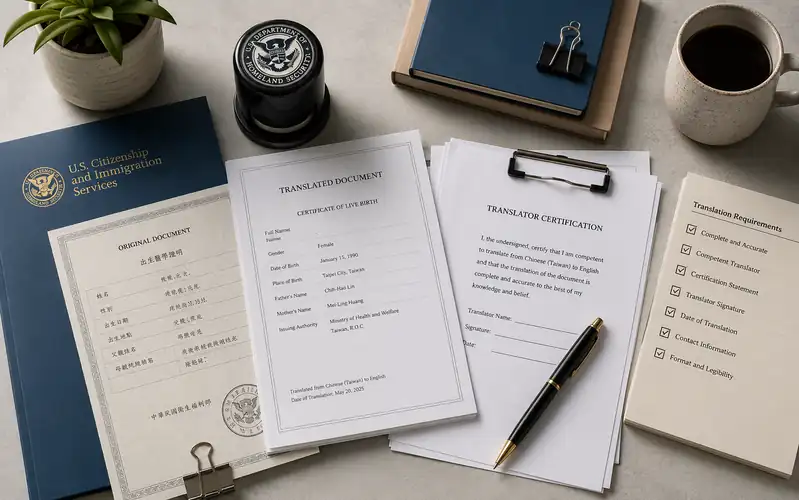
Birth certificates, marriage certificates, divorce records, police certificates, and other civil documents are frequently required in U.S. immigration and visa cases. The translation rule depends on where the case is being processed: documents submitted to USCIS inside the United States are governed by a different translation rule from many immigrant-visa documents submitted through the Department of State and the National Visa Center (NVC).
This guide reflects current published federal guidance reviewed on September 30, 2026. Always follow the document checklist for your exact USCIS form, NVC case, embassy, or consulate because country-specific instructions can change.
USCIS and Department of State Translation Rules Are Not Identical
USCIS Filings
Under 8 C.F.R. § 103.2(b)(3), a foreign-language document submitted to USCIS must be accompanied by a full English translation. The translator must certify that the translation is complete and accurate and that the translator is competent to translate from the foreign language into English.
That rule applies to the foreign-language evidence you actually submit to USCIS. A partial translation or a translation missing the required certification can cause USCIS to give the document reduced or no evidentiary weight.
Immigrant Visa and NVC Cases
The U.S. Department of State currently instructs immigrant-visa applicants to obtain civil documents from the proper official issuing authority. Documents that are not in English or in the official language of the country from which the applicant is applying must generally be accompanied by certified translations. The translation must include a signed statement that it is accurate and that the translator is competent to translate.
This distinction matters. A document that needs an English translation for a USCIS filing may be treated differently in a consular case depending on the language of the country where the visa application is processed.
Which Civil Documents Are Commonly Required?
The Department of State's immigrant-visa guidance lists several common categories of civil documents. The exact documents depend on the visa class, applicant history, and country.
Birth Certificates
Immigrant-visa applicants generally need an original birth certificate or a certified copy issued by the appropriate authority. If the document needs English translation under the applicable rules, translate the complete certificate, including seals, annotations, registration information, and other legible text.
For translation help, see Birth Certificate Translation.
Marriage Certificates
If you are or have been married, the Department of State may require original marriage certificates or certified copies. The document must match the accepted civil-document format for the country that issued it.
See Marriage Certificate Translation.
Divorce, Death, or Annulment Records
Applicants who were previously married may need evidence showing how every prior marriage ended. Depending on the case, this can include a final divorce decree, death certificate, or annulment record. Foreign-language records submitted to USCIS require full certified English translations; consular cases follow the Department of State's language rules for the processing post.
See Divorce Certificate Translation.
Police Certificates
Police-certificate requirements depend heavily on age, nationality, current residence, prior countries of residence, and arrest history. Department of State guidance generally requires police certificates for immigrant-visa applicants age 16 or older under specified residence rules, and it directs applicants to the country-specific Reciprocity information to determine which certificate is acceptable and how to obtain it.
The Department of State's general immigrant-visa guidance says police certificates generally expire after two years, with an exception for certain certificates from a previous country of residence when the applicant has not returned there since issuance. Post-specific embassy or consulate instructions can require a more recent certificate, so always follow the instructions for the location handling your interview.
See Police Certificate Translation.
Passport Biographic Page
For many immigrant-visa processes, applicants submit a photocopy of the biographic-data page of a valid passport and bring the original passport to the interview. A passport translation is not automatically required in every case. Whether additional passport content needs translation depends on the receiving authority and how the document is being used.
If a receiving organization specifically requests an English version, see Passport Translation.
Use the Department of State Reciprocity Schedule
A document can be genuine and still be unacceptable for a U.S. visa case if it is not the type of civil record the Department of State recognizes from that country. The State Department's Reciprocity and Civil Documents by Country resource identifies the appropriate issuing authority, document name, availability, and other country-specific requirements for birth certificates, marriage certificates, police records, passports, and other documents.
Before ordering a translation, confirm that you have the correct version of the source document. Translation does not fix a source document that was issued by the wrong authority or does not satisfy the country-specific document requirement.
How Should a Civil-Document Translation Be Prepared?
For USCIS, the English translation should be full and accompanied by the translator's certification of completeness, accuracy, and competence. For Department of State cases requiring a certified translation, the translation should include the translator's signed statement that the translation is accurate and that the translator is competent.
A complete translation should account for all legible content relevant to the document, including:
- names and dates,
- registration or document numbers,
- issuing authority information,
- stamps and seals,
- handwritten annotations when legible,
- marginal notes and amendments, and
- relevant text on the reverse side.
How to Upload a Translation to NVC/CEAC
The Department of State's Civil Documents FAQ currently instructs applicants who have a certified translation to upload the original foreign-language document and its English translation together in a single file, with the native-language document first and the translation following it.
That is a submission-format rule, not a translation-quality rule. Applicants should still follow the checklist for every required civil document in their case.
Common Mistakes to Avoid
- Using the wrong civil document. Check the State Department Reciprocity page for the country that issued the record.
- Submitting only part of a translation. USCIS requires a full translation of foreign-language documents submitted as evidence.
- Assuming USCIS and NVC rules are identical. They are not; the Department of State considers the official language of the country where the application is processed.
- Leaving seals, stamps, or annotations untranslated. If they contain legible text, they can matter.
- Uploading the translation separately from the original in CEAC. Current NVC guidance says to combine them in one file.
- Assuming translation guarantees acceptance. The receiving agency still determines whether the source document and the complete submission satisfy its rules.
When to Use a Professional Certified Translation
For USCIS evidence, the translation must meet the federal certification requirements. For visa or other official uses, the receiving organization may have its own definition of a certified or professional translation. MAGVAI AGORA prepares certified English translations of civil and personal documents and can help format the translation for official submission, but we do not issue birth certificates, marriage certificates, police certificates, passports, or other government records.
For general certified translation service, visit Certified Translation Services or request a quote.
Frequently Asked Questions
Does USCIS require a certified English translation of every foreign-language document I submit?
USCIS regulations require a full English translation for a foreign-language document submitted to USCIS, together with the translator's certification that the translation is complete and accurate and that the translator is competent to translate into English.
Are NVC translation rules the same as USCIS rules?
No. Department of State immigrant-visa guidance generally requires certified translations for documents not written in English or in the official language of the country where the applicant is applying. Always follow the instructions for your NVC case and U.S. embassy or consulate.
Do I always need to translate my passport?
No. Many visa processes require a copy of the passport biographic page, but a separate English translation is not automatically required in every case. Translate passport content when the receiving agency or institution specifically requires it.
How do I submit a translated civil document to NVC?
Current Department of State guidance says that, when a certified translation is required, the applicant should include the original-language document first and the English translation after it in the same uploaded file.
Official Sources Checked for This Guide
- eCFR — 8 C.F.R. § 103.2(b)(3), Translations
- U.S. Department of State — Civil Documents
- U.S. Department of State — Civil Documents FAQs
- U.S. Department of State — Reciprocity and Civil Documents by Country
Conclusion
For U.S. immigration and visa cases, start with the correct source document, then apply the translation rule for the agency handling the case. USCIS requires full certified English translations of foreign-language documents submitted to it, while Department of State cases use their own civil-document and language rules. A precise translation helps the receiving agency understand the record, but it does not replace the requirement to obtain the correct official document from the proper issuing authority.